Hanzi Home

AnkiWeb addon 888829

Associates mnemonic keywords with traditional Chinese characters, displays character breakdown tables inside Anki cards, and enables quick searches within a Hanzi deck.
AI-generated summary; may contain mistakes.

searchcard-templatesdictionarymobile-compatible

Open on AnkiWeb GitHub Find alternatives

AnkiWeb

Votes
0 (👍 0 · 👎 0)
Updated
2025-02-25
Anki versions
2.1.1~
License
Not found (this does not mean that the addon has no license)
Virus scan
No ClamAV match A match does not prove malware. No match does not prove that the code is safe.
Languages
Python, JavaScript, SQL, JSON
Description language
en

Maintenance

stale

  • Last update or commit: 2025-02-25 (614 days before the snapshot).
  • Commits in the last year: 0.
  • Issues: 0 open, 0 closed.
  • Pull requests: 0 open, 0 merged.

Will it work on my Anki?

Version branches
Min AnkiMax AnkiUpdated
2.1.1+2025-02-25
History across monthly snapshots

Loading…

Similar addons

Hanzi Stats

Calculates how many Hanzi you have learned across configurable HSK, TOCFL, TBCL, and frequency categories, with configurable character lookup URLs and searched fields.

statisticsdictionaryfork-or-reupload

44 votes 88% approval 👍 43 · 👎 1 ⭐ 19 Updated 2023-12-03

Description

Hanzi Home

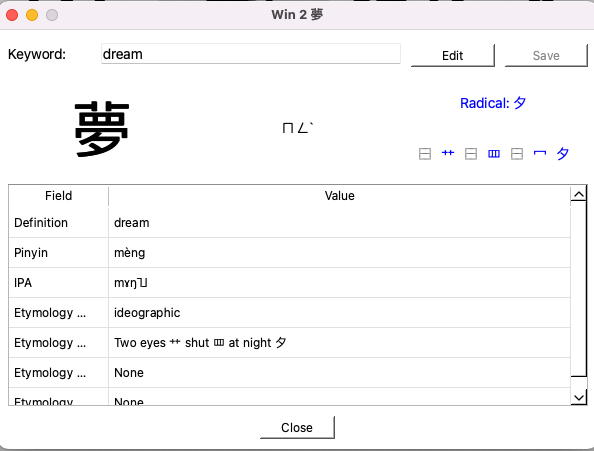
Hanzi Home is an Anki add-on designed to associate keywords with Chinese characters, inspired by the approach of Remembering the Hanzi. The goal is to help you manage information about Hanzi. This addon gives you a way too

  1. look up information about chinese characters
  2. display individual character breakdowns inside a table in your cards.

Information about characetrs stored in json file available on desktop and web. Updates to keywords update this json file

Demo

Demo GIF
Demo GIF

Table View
Table View

Viewer Example
Viewer Example

Table Setup

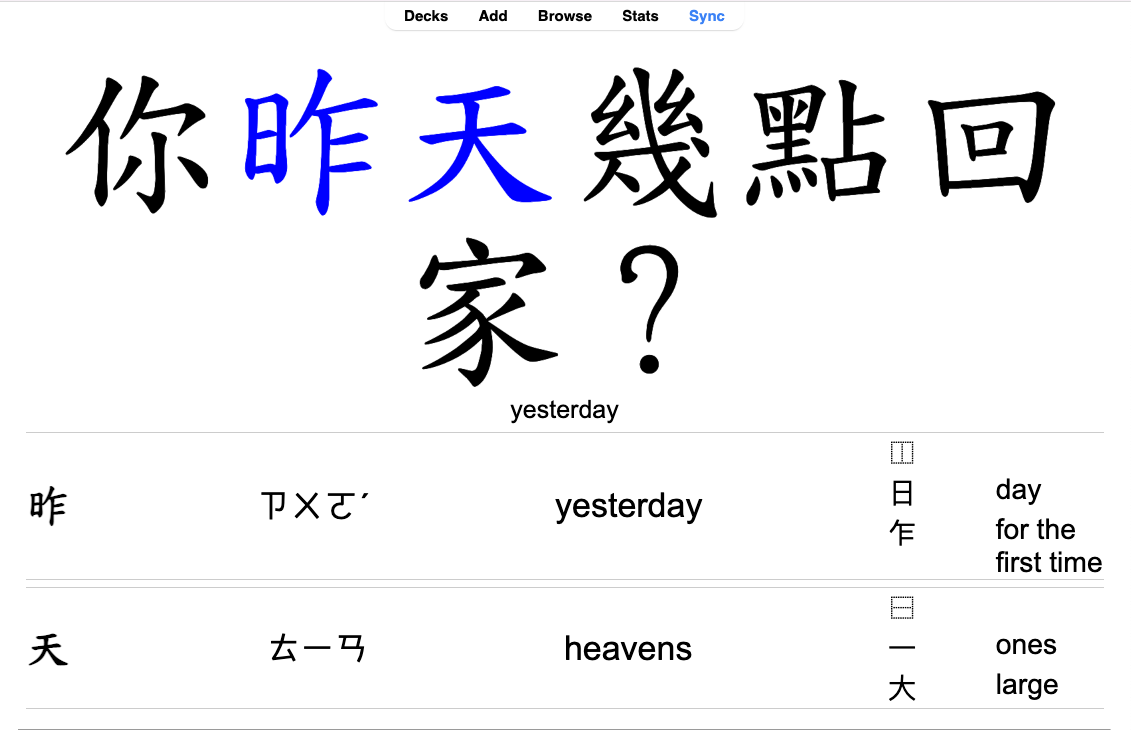
By embedding a simple <div> element onto your Anki card templates (for example, <div id="hanzihome" data="{{Hanzi}}"></div>), this add-on can generate a detailed table for each character. The table displays useful information such as:

  • Keyword (mnemonic “keyword name” for the character)
  • Reading (currently uses Zhuyin, though Pinyin may be added in the future)
  • Potential sub-components (for prioritizing or referencing smaller parts of a character)

If you set it up correctly you will be able to use on Anki Mobile as well. HanziViewer is limited to addon however.

Inside the Card Template Editor add divs to Make Table

  1. Insert the div: In the card template (Front/Back), add:
    <div id="hanzihome" data="{{Hanzi}}"></div>
    
    or for cloze deletions:
    <div id="hanzihome"></div>
    
  2. Configure: Follow the detailed instructions in the add-on’s config file to set up the Hanzi data. You can specify keywords, component details, and more.

Quick Search in your Hanzi Deck

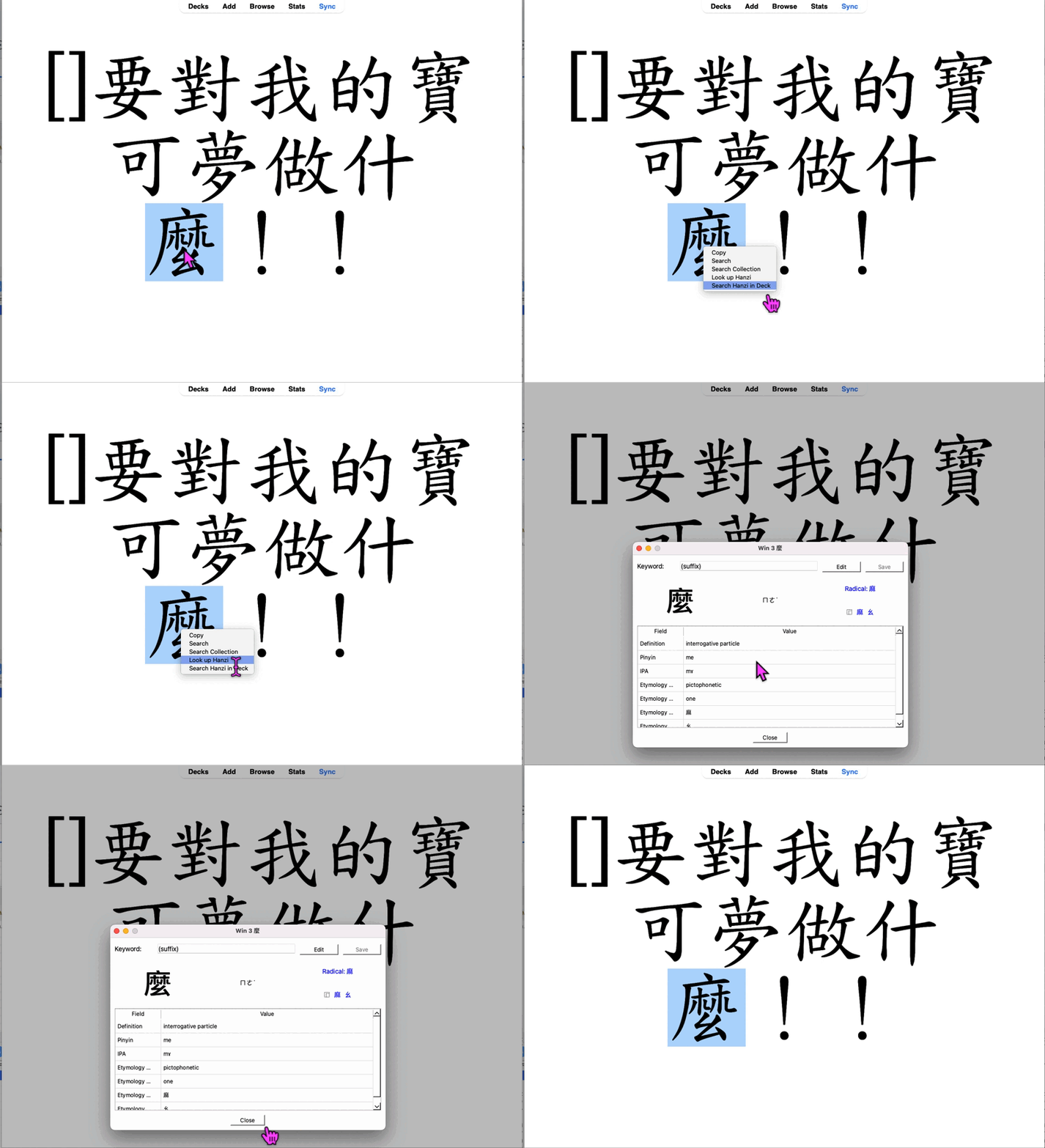
Hanzi Home also makes it easier to search your existing Hanzi Deck (where you study individual characters).

When configured you will be abel so search for selected hanzi more quickly in the browser. I wanted this because I often need to prioritize subcomponents that I have forgotten.

Demo GIF

Quick Search Setup

Go to the config page for Hanzi Home and edit the config file to include

  1. the deck you want to search
  2. the field you want to limit the search to

Restart anki and try a search.

Current Limitations

  • Traditional Focused: Keywords and data focus on Traditional characters. You are probably still able to search and get information about simplified words, they will just lack keywords.
  • Zhuyin only: The add-on displays phonetics in Zhuyin (Bopomofo). Pinyin support is not yet included.
  • Features evolve on demand

Issues or Suggestions

Please open any issues or suggestions on Github

README

Hanzi Home

Hanzi Home is an Anki add-on designed to associate keywords with Chinese characters, inspired by the approach of Remembering the Hanzi. The goal is to help you manage information about Hanzi. This addon gives you a way too

  1. look up information about chinese characters
  2. display individual character breakdowns inside a table in your cards.

Information about characetrs stored in json file available on desktop and web. Updates to keywords update this json file

Download Hanzi Home From Anki Web

Demo

Demo GIF
Demo GIF

Table View
Table View

Viewer Example
Viewer Example

Table Setup

By embedding a simple <div> element onto your Anki card templates (for example, <div id="hanzihome" data="{{Hanzi}}"></div>), this add-on can generate a detailed table for each character. The table displays useful information such as:

  • Keyword (mnemonic “keyword name” for the character)
  • Reading (currently uses Zhuyin, though Pinyin may be added in the future)
  • Potential sub-components (for prioritizing or referencing smaller parts of a character)

If you set it up correctly you will be able to use on Anki Mobile as well. HanziViewer is limited to addon however.

Inside the Card Template Editor add divs to Make Table

  1. Insert the div: In the card template (Front/Back), add:
    <div id="hanzihome" data="{{Hanzi}}"></div>
    
    or for cloze deletions:
    <div id="hanzihome"></div>
    
  2. Configure: Follow the detailed instructions in the add-on’s config file to set up the Hanzi data. You can specify keywords, component details, and more.

Quick Search in your Hanzi Deck

Hanzi Home also makes it easier to search your existing Hanzi Deck (where you study individual characters).

When configured you will be abel so search for selected hanzi more quickly in the browser. I wanted this because I often need to prioritize subcomponents that I have forgotten.

Demo GIF

Quick Search Setup

Go to the config page for Hanzi Home and edit the config file to include

  1. the deck you want to search
  2. the field you want to limit the search to

Restart anki and try a search.

Current Limitations

  • Traditional Focused: Keywords and data focus on Traditional characters. You are probably still able to search and get information about simplified words, they will just lack keywords.
  • Zhuyin only: The add-on displays phonetics in Zhuyin (Bopomofo). Pinyin support is not yet included.
  • Features evolve on demand

Issues or Suggestions

Please open any issues or suggestions on Github