Anki Word Frequency

AnkiWeb addon 110659003

Adds logarithmically scaled word-frequency scores to selected Anki cards via a right-click menu, using configurable input/output fields and selectable languages.
AI-generated summary; may contain mistakes.

note-management

Open on AnkiWeb GitHub Find alternatives

AnkiWeb

Votes
9 (πŸ‘ 8 Β· πŸ‘Ž 1)
Updated
2025-08-09
Anki versions
25.07~
License
AGPL-3.0 (from the GitHub repository)
Virus scan
No ClamAV match A match does not prove malware. No match does not prove that the code is safe.
Languages
Python, CSV, JSON, YAML, HTML, Ignore List, JavaScript, HCL
Description language
en

Maintenance

stale

  • Last update or commit: 2025-08-09 (449 days before the snapshot).
  • GitHub Actions workflows: 1.
  • Commits in the last year: 0.
  • Issues: 0 open, 9 closed.
  • Pull requests: 0 open, 5 merged.
  • Median first response: 41 hours (9 answered issues and pull requests).
  • Outside pull requests: 60% of 5 merged.

GitHub

Repository
kamoo1/anki-word-freq Β· more by kamoo1
Stars
⭐ 3 · forks 2 · open issues 0
Last commit
2025-07-19
License
AGPL-3.0
Languages
Python, Shell, Makefile
Tests
0

Will it work on my Anki?

Version branches
Min AnkiMax AnkiUpdated
2.1.225.02.72025-07-19
25.07+2025-08-09
History across monthly snapshots

Loading…

Similar addons

Frequency Updater (JPDB + CC100)

Automatically updates frequency fields on cards using custom JPDB, CC100, or other word lists, scanning selected decks and subdecks with configurable field and sorting options.

note-management

2 votes 9% approval πŸ‘ 1 Β· πŸ‘Ž 1 Anki 2.1.66~ Updated 2025-10-07
Random Word Generator

Generates random word lists from text files or card templates, with options to limit words by position range and list length for vocabulary practice.

card-creationcard-templates

1 votes 21% approval πŸ‘ 1 Β· πŸ‘Ž 0 ⭐ 0 Anki 2.1.47~ Updated 2022-03-30
Scale Images archived

Scales images while editing notes by setting a configurable CSS max-height for selected fields, offering individual and bulk scaling via keyboard shortcuts or buttons.

note-managementformattingshortcuts

18 votes 82% approval πŸ‘ 18 Β· πŸ‘Ž 0 ⭐ 6 Anki 25.02~ Updated 2025-03-13
Freqman

Imports Yomichan frequency dictionaries and sorts selected card types by frequency or rank, with preferences, database resets and troubleshooting options.

importreview-flownote-management

1 votes 21% approval πŸ‘ 1 Β· πŸ‘Ž 0 ⭐ 5 Anki 2.1.56~ Updated 2023-01-23

Description

Anki Word Frequency

Add word frequency to your Anki cards, powered by wordfreq.

Frequency value is logarithmically scaled for readability, defined here.

Supported languages listed here.
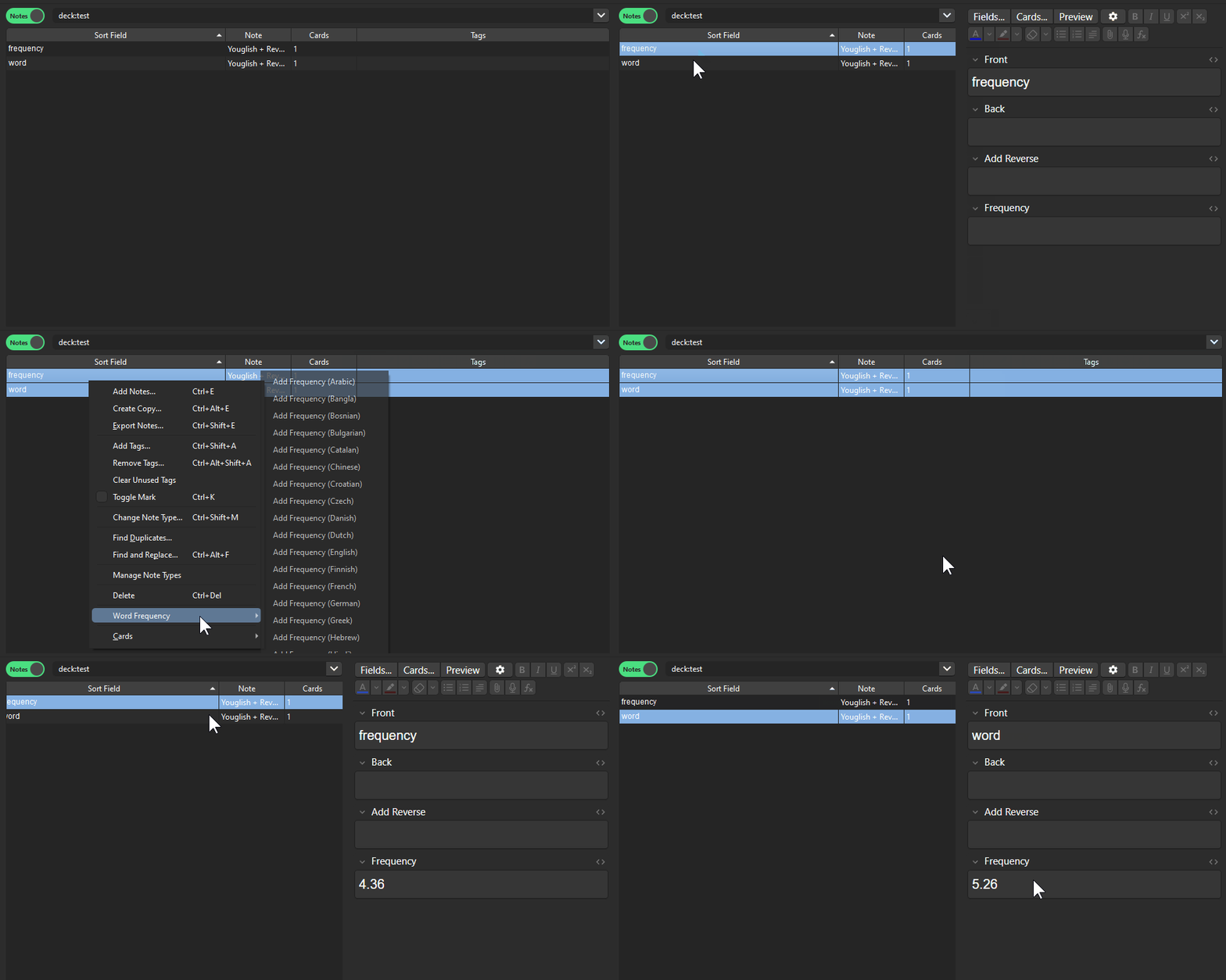
recording

Usage

  1. Update your card type to include both the input and output fields defined in your config. For example, if you're studying English verb forms and your config looks like this:

    "fields": {
        "Front": "Base Frequency",
        "Past Tense": "Past Frequency",
        "Past Participle": "Participle Frequency"
    }
    

    then your card should have fields named Front, Past Tense, Past Participle, and matching output fields like Base Frequency, Past Frequency, and Participle Frequency.

  2. In the Anki browser, select the cards you want to update, right-click and choose your desired language from the "Word Frequency" menu. The add-on will analyze each input field and update the corresponding output field with a frequency score.

Config

fields
A dictionary mapping input fields (to analyze) to output fields (to store frequency).
Example: {"Front": "Frequency"}

output_is_inverted
Whether the frequency should be inverted, i.e. {output_upper_bound} - {frequency}

output_upper_bound
The maximum frequency value. Anything above 8 is safe.

listed_languages
A list of language codes you want to display in Anki Word Frequency menu, e.g. ["en", "zh", "de"]. An empty list will display all available options.

Known Issues

  • For Chinese Japanese and Korean (CJK) support, you can find a CJK version in GitHub releases. It's too large for AnkiWeb.
  • Some Linux distributions use newer versions of Python, you can find these builds (ranges from Python3.9 to 3.13) in GitHub releases, you can look up your Python version in Anki by going to Help > About.
  • Some custom tokenizers in the dependencies write logs to stderr (e.g. jieba), this will get displayed in a error popup window in Anki, but can be safely ignored.

README

Anki Word Frequency

Add word frequency to your Anki cards, powered by wordfreq.

Frequency value is logarithmically scaled for readability, defined here.

Supported languages listed here.

recording

Usage

  1. Update your card type to include both the input and output fields defined in your config. For example, if you're studying English verb forms and your config looks like this:

    "fields": {
        "Front": "Base Frequency",
        "Past Tense": "Past Frequency",
        "Past Participle": "Participle Frequency"
    }
    

    then your card should have fields named Front, Past Tense, Past Participle, and matching output fields like Base Frequency, Past Frequency, and Participle Frequency.

  2. In the Anki browser, select the cards you want to update, right-click and choose your desired language from the "Word Frequency" menu. The add-on will analyze each input field and update the corresponding output field with a frequency score.

Config

Field Description
fields A dictionary mapping input fields (to analyze) to output fields (to store frequency). Example: {"Front": "Frequency"}.
output_is_inverted Whether the frequency should be inverted, i.e. {output_upper_bound} - {frequency}.
output_upper_bound The maximum frequency value, anything above 8 is safe.
listed_languages A list of language codes you want to display in Anki Word Frequency menu, e.g. ["en", "zh", "de"]. An empty list will display all available options.

Known Issues

  • For Chinese Japanese and Korean (CJK) support, you can find a CJK version in GitHub releases. It's too large for AnkiWeb.
  • Some Linux distributions use newer versions of Python, you can find these builds (ranges from Python3.9 to 3.13) in GitHub releases, you can look up your Python version in Anki by going to Help > About.
  • Some custom tokenizers in the dependencies write logs to stderr (e.g. jieba), this will get displayed in a error popup window in Anki, but can be safely ignored.